The Hiring Decision That Affects Everything
Should I hire a virtual assistant, a freelancer, or a full-time employee?
It depends entirely on the type of work you need done. Each model has a different cost structure, flexibility profile, and suitability for different tasks. Choosing the wrong one is a recurring monthly expense most businesses do not notice until it compounds into a real problem.
“The wrong hire is not just a cost. It is a compounding drag on your business that shows up in your margins, your team focus, and your growth rate.”
Every growing business hits the same crossroads. The workload has outgrown the founding team. More support is needed, but what kind?
You might be wondering, isn’t this a simple decision? Just find someone good and hire them. The truth is, the model you choose has a bigger impact on your growth trajectory than most business owners realise.
A virtual assistant, a freelancer, and a full-time employee are not three versions of the same thing at different price points. They are structurally different arrangements. And the rise of AI virtual assistant services has made this decision even more consequential.
This guide breaks each option down honestly, what it truly costs, where it performs, where it falls short, and how to decide with confidence.
Understanding the Three Options: What Each One Actually Means
What is the difference between a virtual assistant, a freelancer, and a full-time employee?
A virtual assistant provides ongoing remote support within your workflows on a continuous basis. A freelancer completes a specific project with a defined end date. A full-time employee works exclusively for your business under a permanent employment arrangement, highest cost, deepest integration, least flexibility.
Before comparing them directly, it helps to be precise about what each option actually is. Loose use of these terms creates confusion at exactly the point where clarity matters most.
A virtual assistant (VA) is a remote professional providing ongoing operational, administrative, or specialist support, working within your workflows, tools, and processes on a continuous, dedicated basis.
A freelancer is an independent contractor hired for a specific project or deliverable with a defined scope and end date. They typically work for multiple clients simultaneously and manage their own schedule.
A full-time employee works exclusively for your business under a permanent arrangement, the highest-commitment option with the greatest compliance obligation and the highest total cost.
Here’s the thing, most hiring mistakes happen not because business owners choose the wrong person, but because they choose the wrong model for the type of work they need done.
The Real Cost of Each Option (With Data)
How much does it actually cost to hire someone in the USA?
According to the SHRM 2025 Benchmarking Report, the average cost-per-hire for a nonexecutive role in the USA is $5,475. Executive hires average $35,879, nearly 7x higher. These are recruitment costs alone, before salary, benefits, office, or equipment are factored in. Only 20% of organizations even track whether those hires delivered quality outcomes.
Cost is where the differences between these three models become most consequential for small and growing businesses.
Most business owners only think about base salary. The SHRM 2025 data makes clear that the cost of a full-time hire extends well beyond it, starting with the hiring process itself.
SHRM 2025 Benchmarking Report, Key Recruiting & Hiring Findings
Survey of 2,371 SHRM members conducted January–March 2025 across diverse US industries, sectors, and organization sizes.
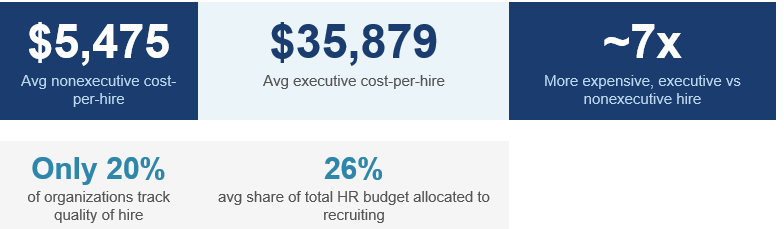
Source: SHRM 2025 Benchmarking Reports (October 2025), shrm.org/benchmarking
Freelancers have no benefits or tax obligations, but specialist freelancers in the USA charge premium project rates. Scope creep and availability gaps significantly increase the real cost over time.
A dedicated virtual assistant hired from India through a professional provider costs a fraction of a full-time hire, with predictable monthly fees and zero employment overhead.
Think about it this way, the $5,475 average cost-per-hire is just the start. Add salary, benefits, office, and equipment and the total annual commitment becomes significantly larger. A VA sidesteps all of that.
Flexibility and Scalability: Which Model Grows With You?
Which hiring model is most flexible for a growing business?
Virtual assistants offer the most practical flexibility. You can scale hours up as workload grows, reduce them during quieter periods, and change scope, all within the same working relationship. Full-time employees are the least flexible. Freelancers are unreliable for ongoing operational work.
Flexibility matters differently depending on what stage your business is at. Early-stage companies need to avoid fixed commitments that outlast the need for them.
Full-time employees are the least flexible option by design. Hiring takes weeks or months. Ending the arrangement is slow, costly, and legally complex.
Freelancers offer more flexibility on paper, but a freelancer who is fully booked when you need them is simply unavailable. Mid-project departures for better-paying work are a real operational risk.
Virtual assistants offer the most practical flexibility. Scale up as workload increases, reduce during quieter periods, all within the same working relationship, without a new hiring process.
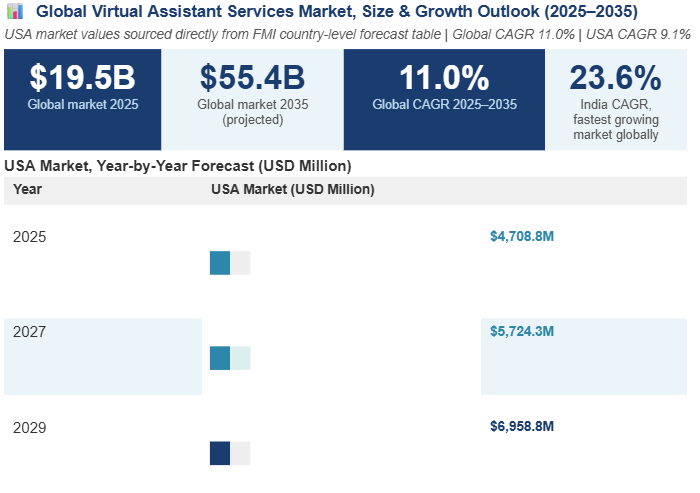
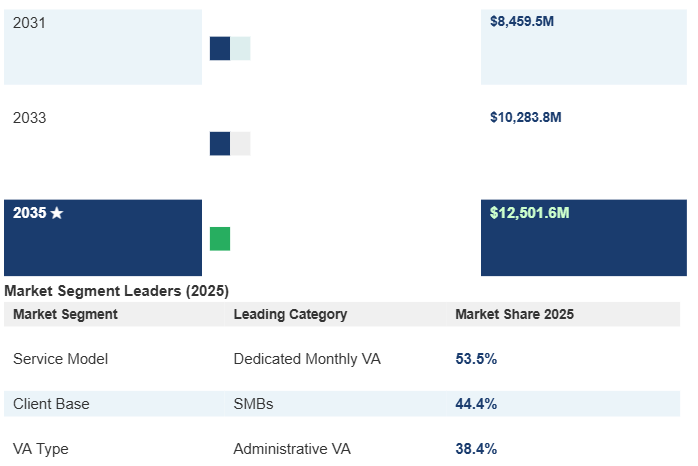
★ 2035 projected figure | USA yearly values sourced directly from FMI country-level forecast table. Source: Future Market Insights, Virtual Assistant Services Market Size and Share Forecast Outlook 2025 to 2035 (Published September 15, 2025)
A global VA market growing from $19.5 billion in 2025 to a projected $55.4 billion in 2035 reflects genuine, sustained adoption by businesses worldwide, not a passing trend.
The USA alone is forecast to grow from $4.7 billion to $12.5 billion over the same period at a 9.1% CAGR, the dedicated monthly VA model leading at 53.5% of global market share.
So what does that mean in practice? It means the infrastructure, training standards, and AI tools supporting VAs have never been more mature. The risk of choosing a VA has never been lower.
Quality and Consistency: Who Delivers More Reliable Output?
Can a virtual assistant deliver the same quality and consistency as a full-time employee?
For recurring, process-driven operational work, yes. Dedicated virtual assistants sourced through a professional provider work exclusively within your workflows, learn your standards over time, and are accountable for output quality to both you and the provider.
Consistency is undervalued in most hiring decisions. For operational business functions, it is frequently more important than raw skill level.
Freelancers are typically skilled within their specialty, but consistency is their structural weakness. Most juggle multiple clients simultaneously. Your work competes for their attention.
Full-time employees deliver the highest consistency when well-managed, but that comes with significant management overhead and a slow, costly process when performance issues arise.
Dedicated virtual assistants, sourced through a professional provider, develop the consistency of a full-time hire over time, learning your standards, preferences, and workflows at a fraction of the cost.
You might be wondering, is consistency really that important? For operational work like scheduling, inbox management, or CRM updates, an inconsistent resource is often worse than no resource at all.
When to Choose a Freelancer
When is a freelancer the right choice for a business?
A freelancer is the right choice when the work is clearly bounded, non-recurring, and requires specialist expertise your business does not need on an ongoing basis, such as a brand identity project, website build, video production, or one-time technical project.
The most appropriate freelancer use cases share two consistent characteristics: a clear end point and a specialist skill your team does not have and will not need repeatedly.
- A one-time brand identity project, logo, visual identity, brand guidelines, requiring specialist creative input for a defined deliverable.
- A website build or technical development project with clear scope, defined deliverables, and a finite end date.
- Specialist content, a whitepaper, video production, photography shoot, where you need a specific skill for a single output.
- Short-term technical work, a software integration, data migration, or one-time audit, where you need expertise for weeks, not months.
If the work has a clear end point and requires skills your team does not have and will not need repeatedly, a freelancer is the most efficient answer for that specific scenario.
When to Choose a Full-Time Employee
When does a full-time employee make more sense than a virtual assistant?
A full-time employee is the right choice for senior leadership roles, positions requiring physical presence, and functions involving the deepest levels of organisational trust, strategic authority, and cultural responsibility. For recurring operational support tasks, a virtual assistant is almost always the more cost-effective and flexible solution.
Full-time employment is right when the role is genuinely strategic, deeply embedded in your organization, or involves a level of trust that a more arms-length arrangement cannot provide.
- Senior leadership roles, CFO, VP of Product, Head of Sales, requiring team leadership, high-stakes decisions, and deep organizational embedding.
- Roles requiring physical presence, warehouse manager, retail supervisor, laboratory technician, where the work cannot be performed remotely.
- Positions where institutional knowledge is the core value, a long-tenured account manager whose client relationships are a primary business asset.
- Functions handling the most sensitive strategic, legal, or financial information at the highest trust level within the organization.
For these roles, the cost of full-time employment is genuinely justified. The mistake most businesses make is applying this logic to roles that simply do not require it.
When to Choose an AI Virtual Assistant Service
What types of work are best suited to an AI virtual assistant service?
AI virtual assistant services are best suited to recurring, process-driven operational work that requires reliability and consistency over strategic judgment, including administrative support, customer communication, research, CRM management, marketing execution, e-commerce operations, and industry-specific coordination tasks.
This is the broad middle ground of business operations, the substantial volume of work that keeps a business running and growing. This is where AI virtual assistant services USA have become particularly powerful, because AI-supported VAs handle a wider range of tasks with higher accuracy than traditional remote support models.
The range of work meeting these criteria is far broader than most business owners initially assume:
- Administrative and calendar management: scheduling, inbox management, travel coordination, document preparation, meeting follow-up.
- Customer support and communication: handling inquiries, managing tickets, following up with clients, managing live chat.
- Research and data tasks: competitor research, prospect list building, CRM management, market intelligence.
- Marketing execution: social media scheduling, email campaigns, content publishing, performance reporting.
- E-commerce operations: listing management, order processing, inventory monitoring, returns handling.
- Industry-specific support: legal admin, real estate coordination, healthcare scheduling, logistics tracking.
📊 Primary Drivers for Traditional Outsourcing, Deloitte Global Outsourcing Survey 2022
% of 500+ executives globally citing each as primary driver for Traditional Outsourcing | Exact figures from survey report

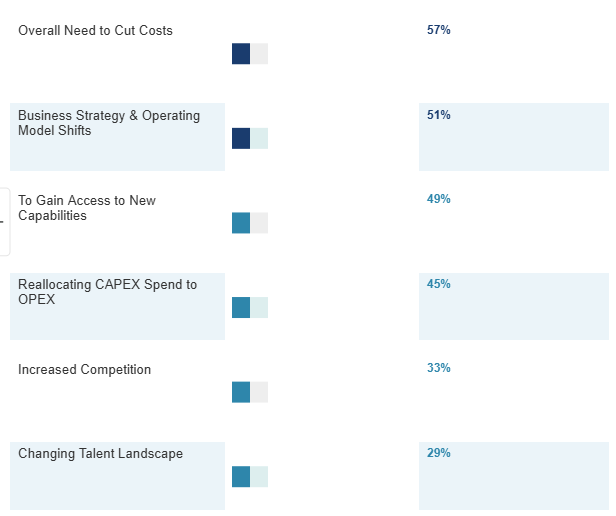
Additional Key Findings from the Same Survey

Cost reduction is the leading driver of outsourcing at 57%, but access to new capabilities (49%) and business strategy shifts (51%) are rapidly closing the gap. Virtual assistants serve all three motivations simultaneously.
The real question is not whether virtual assistant services work. It is whether the tasks you are paying a full-time salary for actually require a full-time employee, or whether the numbers have already answered that for you.
The AI Advantage: Why AI Virtual Assistants Are Raising the Standard
How do AI virtual assistant services differ from traditional virtual assistant services?
AI virtual assistant services combine trained human professionals with advanced AI tools for research, document creation, scheduling, and communication management. This delivers faster turnaround, higher output quality, and broader task coverage than traditional VA models, narrowing the gap with full-time in-house hires for a wide range of operational functions.
The traditional concern about virtual assistants, that the quality ceiling was lower than an in-house hire, is becoming increasingly obsolete.
AI tools have dramatically expanded what a well-trained, AI-supported VA can deliver. Research that once took 3 hours takes 45 minutes. Document drafts that needed multiple revisions are cleaner on the first pass.
Natural language processing improves written output quality. AI research tools surface more comprehensive information faster. Workflow automation reduces error rates significantly across administrative tasks.
Think about it this way, reactive hiring adds a fixed cost to your business regardless of demand. An AI-supported VA gives you the same output quality with the flexibility to scale up or down as your business actually needs.
How to Make the Right Decision for Your Business
How do I choose between a virtual assistant, freelancer, and full-time employee?
Work through three questions in order: Does the work have a clear end point? If yes, freelancer. Does it require physical presence or senior organizational authority? If yes, full-time employee. Is it recurring, process-driven, and deliverable remotely? If yes, virtual assistant. Most growing businesses discover that more of their support needs fall into the VA category than they initially expected.
A clear, practical framework makes this decision actionable. Work through these three questions before committing to any hiring model.
Question 1: Does this work have a clear end point?
If yes, it is project work. A freelancer is almost always the right answer. If no, it is ongoing operational work. Move to Question 2.
Question 2: Does this role require physical presence, team leadership, or the highest level of organizational trust?
If yes, a full-time employee is justified. The cost of employment is warranted by the depth of embedding the role requires. If no, move to Question 3.
Question 3: Is this work recurring, process-driven, and manageable by a skilled remote professional?
If yes, a virtual assistant is almost certainly the right answer. Consistent, operational, deliverable remotely, and not requiring strategic authority.
Most businesses that work through these three questions discover that a larger share of their total support needs falls into the VA category than they initially assumed.
Here’s the thing, the goal is not to choose the cheapest option. It is to match the right model to the right type of work. Get that right and the cost, quality, and flexibility all take care of themselves.
Conclusion: Match the Model to the Work
The decision between a virtual assistant, a freelancer, and a full-time employee is not a question of which is generally better. It is a question of which is right for the specific work you need done.
Freelancers for one-off specialist projects. Full-time employees for senior strategic roles. Virtual assistants for the broad, recurring operational work between those two extremes.
For most growing businesses in the USA, all three have a place in a well-structured team. The mistake is applying the wrong model to the wrong type of work, and paying for it every month.
If you want to understand exactly what an AI-supported virtual assistant could handle for your specific business needs, get in touch with the Data Qualytic team for a free, no-obligation consultation.